

Preamble
Looks like the summer growing season is coming to an end. We could get the first frost any night now, so I’ve been out there picking what’s left: the last of the fresh herbs, the last few tomatoes, and whatever the summer annuals still have to give.
It always sneaks up on me. One week I’m watering every morning and wondering if the zinnias will ever slow down, and the next I’m checking the overnight temperatures and pulling the pots closer to the house.
It’s also grape harvest time, and not too long ago I got to celebrate it in a way I never expected to, with my bare feet. More on that below.
Farm Stand Report
The mums have finally burst open. I’d been watching them sit in tight buds for weeks, and now the whole stand is covered in rust and gold and burgundy.
The Concord grapes are in, too, if you want to try this week’s featured recipe.
This time of year, there’s one farm I always visit because they go all out for Halloween. It makes a full day for families. There are hayrides, a petting zoo, a corn maze, pumpkin painting and face painting, a picnic grove if you bring lunch, and, of course, the pumpkin patch. They also have those painted photo boards with holes cut out for your face, and the children (and plenty of grown-ups) line up to stick their heads through.
My advice is to get there early, because by late morning it’s packed.
Weekend Menu
Friday
Concord Grape Spritzer (grape juice, sparkling water, a squeeze of lemon)
Harvest Board: sharp provolone, pecorino, toasted walnuts, honey, and small clusters of red and Concord grapes
Sausage and Grapes (salsiccia e uva), the classic Umbrian skillet dish, with crusty bread
Saturday
Morning: Ricotta Pancakes with Warm Concord Grape Syrup
Dinner: Rosemary Roast Chicken Thighs with Roasted Red Grapes and Shallots
Crispy Smashed Potatoes with Garlic and Parmesan
Roasted Cauliflower with Lemon and Toasted Breadcrumbs
Sunday
Espresso and Anise Biscotti
Baked Rigatoni with Sunday Sauce and Ricotta
Featured Recipe: Schiacciata all’Uva (Tuscan Grape Harvest Focaccia)
Featured Recipe: Schiacciata all’Uva (Tuscan Grape Harvest Focaccia)
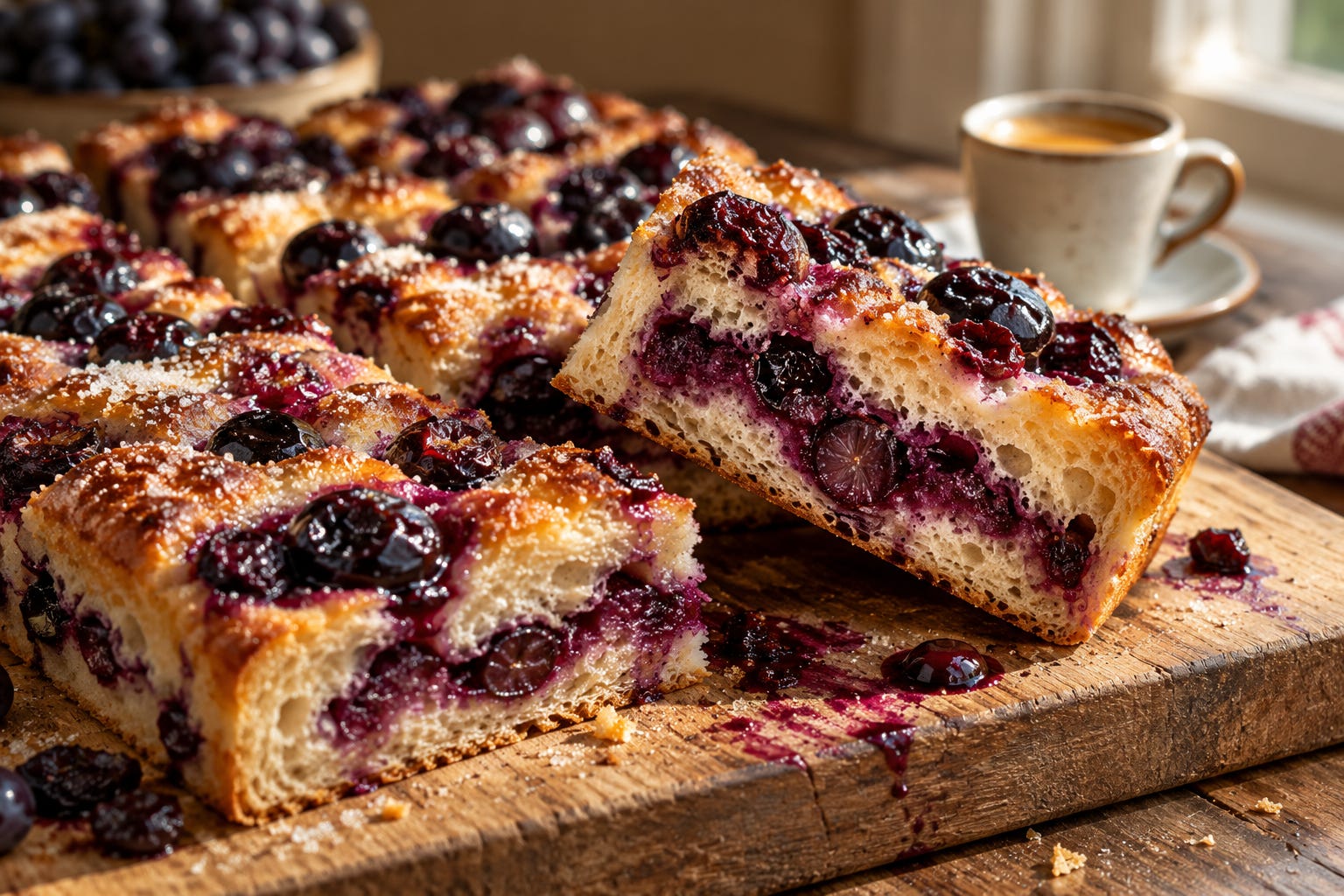
I went from stomping grapes to baking with them. Schiacciata all’uva is a flat Tuscan bread that families make at harvest time, layered with grapes that burst in the oven and turn jammy. This is my first time baking it, so I’ll be trying it right along with you this weekend. Traditionally, the seeds stay in for a little crunch, and I’ve put some options for that in the notes.
Serves: 8 to 10 Prep: 30 minutes, plus about 2½ hours rising Bake: 45 to 50 minutes
Ingredients
For the dough
4 cups (500 g) all-purpose flour
2¼ teaspoons (1 packet) instant yeast
1 tablespoon sugar
1½ cups warm water (about 110°F)
1 teaspoon kosher salt
3 tablespoons extra-virgin olive oil, plus more for the pan
For the filling and topping
2 lb Concord grapes, stemmed, rinsed, and patted dry
⅓ cup sugar, divided
3 tablespoons extra-virgin olive oil, divided
1 teaspoon anise seed or 1 tablespoon chopped fresh rosemary (optional)
Directions
Make the dough. In a large bowl, whisk together the flour, yeast, and sugar. Add the warm water and olive oil and stir until a shaggy dough forms, then add the salt. Knead on a lightly floured counter for 8 to 10 minutes, until smooth and elastic.
First rise. Place the dough in an oiled bowl, cover with a towel, and let it rise in a warm place until doubled, about 1½ to 2 hours.
Prepare the pan. Generously oil a 9x13-inch baking pan. Divide the dough in half. Press one half into the pan, stretching it to the edges with oiled fingertips. If it springs back, rest it 10 minutes and try again.
First layer. Scatter half the grapes over the dough. Sprinkle with half the sugar and half the anise or rosemary, if using, and drizzle with 1 tablespoon of olive oil.
Top layer. Stretch the second half of the dough into a rough 9x13 rectangle and lay it over the grapes. Pinch the edges together as best you can; it doesn’t need to be perfect. Press the remaining grapes firmly into the top so they sink in slightly. Sprinkle with the remaining sugar and anise or rosemary, and drizzle with the remaining 2 tablespoons of oil.
Second rise. Cover loosely and let it rise 30 to 45 minutes while the oven heats to 400°F.
Bake. Bake 45 to 50 minutes, until the top is deep golden and the grape juices are bubbling and jammy at the edges. If the top browns too fast, tent loosely with foil for the last 10 minutes.
Cool before cutting. Let it cool in the pan at least 30 minutes so the juices set. Cut into squares and serve warm or at room temperature.
Notes
About the seeds: traditionally the seeds stay in for a pleasant crunch. If that’s not for you, halve and seed the Concords (tedious but doable), or use red seedless grapes. The flavor will be milder and less jammy.
It will stain. Concord juice is deep purple, so use a pan you don’t mind marking, or line it with parchment.
Make ahead: it’s best the day it’s baked, but it keeps covered at room temperature up to 2 days. Don’t refrigerate it, or the bread turns tough.
How to serve: with espresso in the afternoon, or alongside cheese as a sweet-and-savory finish to Sunday dinner.
Shoppable List
Quantities are for a table of 4 to 6.
Produce
4 lb Concord grapes (schiacciata, syrup, and the board)
3 lb red seedless grapes (sausage, chicken, and the board)
2 lb small Yukon Gold potatoes
1 large head cauliflower
4 shallots
1 yellow onion
2 heads garlic
3 lemons
1 bunch fresh rosemary
1 bunch fresh basil
Meat & Dairy
2 lb Italian sausage links, sweet or hot
3 lb bone-in, skin-on chicken thighs
1 lb sharp provolone
1 wedge Pecorino Romano
1 wedge Parmigiano-Reggiano
2 lb whole-milk ricotta (pancakes and rigatoni)
1 lb fresh mozzarella
1 dozen eggs
Milk
Butter
Pantry
1 lb rigatoni
2 (28 oz) cans crushed tomatoes
All-purpose flour
Instant yeast
Sugar
Baking powder
Extra-virgin olive oil
Balsamic vinegar
Honey
Walnuts
Plain breadcrumbs
Kosher salt and black pepper
Anise seed (optional, for the schiacciata)
Bakery & Drinks
1 crusty Italian loaf
Anise biscotti, bakery-bought or homemade
Espresso
Concord grape juice
Sparkling water
Curious what’s in my kitchen? Shop Nonna’s Favorites →
Something New Is Coming
I’ve been sewing, crafting, and making over thrift-store finds most of my life, and now I’m putting it on video. My new channel, Kathleen Makes, is coming soon with DIY, craft, and upcycling projects. I’ll let you know here when the first ones are up.
Nonna’s Notebook
Who would have thought that the Northeast, and New Jersey in particular, was its own wine country? I sure didn’t, until I spent an afternoon at Laurita Winery out in New Egypt, right here in Central Jersey.
They offer grape stomping, and just like Lucy in that I Love Lucy episode, I had to have a go at it. I couldn’t find a costume red wig large enough to fit me, but I did pull off the old-world peasant outfit, climbed into the tub, and went stomping away. The grapes are cold and slippery, and they squish up between your toes, and I could not stop laughing. So much fun, so many laughs.
What surprised me about Laurita is that the whole place runs on solar power. Every part of the winemaking process is powered by the sun. The venue itself is lovely and perfect for a fun outing, and they keep a full calendar of events, so there’s always a reason to go back.
As for the wine, I’ll give you my honest opinion as someone who enjoys a glass, but is by no means an expert. It’s drinkable, but it isn’t on a par with the world-class wines of Europe, South America, or some of the California wines. A lot of what they pour is on the lighter side, often with fruit flavors added. I didn’t go for the wine, though. I went to stomp grapes, and I’d go back and do it again.
Around the House: My Little Garden Experiment
I’m trying something this fall, and I’ll let you know in the spring how it went.
I deadheaded my zinnias and saved the dry seed heads to plant next year. If your zinnias came from a packet of hybrid seeds, the flowers you grow from saved seed may not look exactly like the parent plant, but I don’t mind a surprise.
The experiment is what I’m doing with everything else. Instead of bagging up the spent plants, tomato plants included, I’m “planting” them. I’m dumping them in an open area of the yard, covering them with the soil they grew in, and taking my chances. If something comes back next year, great. If not, they’ll break down over the winter and serve as mulch to enrich that bed. Gardeners even have a name for this, trench composting, so I’m not as crazy as I sound.
One caution if you try it with tomato plants: they can carry blight that lives over the winter in the soil, so bury them somewhere you won’t be planting tomatoes, peppers, or eggplant next year.
Rotating Feature: New Jersey Wine Country
New Jersey has four official wine-growing regions.
The largest is the Outer Coastal Plain, which covers nine counties in the southern part of the state.
The Atlantic Ocean and the Delaware Bay keep the weather there milder, and the flat, sandy soil drains well, which grapes need.
Cape May has more frost-free days than anywhere else in the state, so its growing season runs the longest.
Our summers are humid, and humidity means mildew and mold on the vines. That’s why a lot of Jersey vineyards grow French-American hybrid grapes like Chambourcin and Vidal Blanc, which hold up better in our weather.
Fruit wines made from blueberries, apples, and even Asian pears are a longtime Jersey tradition, which explains all the fruity wines on the tasting lists.
Back in 1767, two New Jersey men were recognized by a society in London for growing grapes and making wine here, nine years before the Declaration of Independence.
Welch’s grape juice started in Vineland, New Jersey, in 1869, when Thomas Welch figured out how to pasteurize Concord grape juice so it wouldn’t ferment.
Worth Knowing: Putting Container Herbs and Geraniums to Bed
When frost is in the forecast, here’s what to do with your pots.
Geraniums. These aren’t true annuals. They’re tender perennials, so they’ll come back year after year as long as they don’t freeze. There are two easy ways to keep them.
Keep them growing. Bring the pot inside, cut the plant back by about a third to a half, water it well, and put it in your sunniest window. They do best in a cool room, around 55 to 65 degrees.
Let them go dormant. Cut them back and move the pot somewhere cool and dim that won’t freeze, like the basement or an attached garage. Give them just enough water to keep the soil from drying out completely. In spring, trim off any dead stems and bring them back into the light.
Thyme, oregano, sage, and chives. These are hardy, and in most of New Jersey they can stay outside in their pots. Group the pots together against the house where they’re out of the wind, and make sure they drain well, because sitting in wet soil will kill them faster than the cold will. The chives will die back but come up again in spring.
Rosemary. Bring it inside. It’s iffy in our winters, especially in a pot. Give it a bright window in a cool room and keep the soil lightly moist but not wet.
Parsley. Dig it up with as much of the root as you can and put it in a deep pot, and you can keep cutting it all winter.
Basil. It won’t make it through the first frost, so pick it all now. I’d make pesto.
Weekend Kitchen Planner
Thursday
Shop from the list above.
Make the Sunday sauce for the rigatoni and refrigerate it. It’s better on day three anyway.
Make the Concord grape syrup for Saturday’s pancakes; it keeps in the fridge up to a week.
Friday
Set out the cheeses an hour before guests arrive so they come to room temperature.
Build the harvest board and mix the spritzers.
Sausage and grapes go in the skillet last and take about 30 minutes start to finish.
Saturday
Morning: ricotta pancakes; warm the grape syrup gently while the griddle heats.
Midday: assemble the baked rigatoni, cover, and refrigerate for tomorrow.
Afternoon: boil the potatoes for smashing and cut the cauliflower into florets.
Dinner: the chicken, potatoes, and cauliflower all roast at 425°F so everything can share the oven.
Sunday
First thing: mix the schiacciata dough so it’s risen by late morning.
Late morning: assemble the schiacciata and let it do its second rise.
Midday: bake the schiacciata, then take the rigatoni out of the fridge to come to room temperature.
Afternoon: bake the rigatoni (about 45 minutes covered, then 15 uncovered), and serve the schiacciata with espresso and biscotti to finish.
Worth Keeping
“Who would have thought New Jersey was its own wine country?”
Before You Go
As much as I don’t like rushing the seasons, I also don’t like the stress the holidays bring, so I’ve already started my Christmas shopping, a gift here and there.
The trouble is, I need a better system. I often forget where I put the gifts, and something always turns up after Christmas that I’d completely forgotten about. Then there’s knowing when to stop. I keep seeing things I think my family will like, and I can’t help myself.
So I’m asking you. How do you keep track of the gifts you’ve bought and where you’ve hidden them? And how do you decide when you’re finished? Reply to this email or leave a comment, and I’ll share your best ideas in a future issue.
See you next Friday. Bring your appetite.
— The Jersey Nonna
Wrap the gift and put a sticky on it with a number. On a sheet of paper write down the number, what the gift is, who it’s for and where you put it.