

Preamble
I noticed it for the first time last night — dusk arriving earlier, just like that. One day it’s still light at 8, and now it’s darkening before 7:30. I’m one of those people affected by the shortened days. I want to hibernate — close the drapes, put on my pajamas, and hunker down with a book, some knitting, or a good bingeable show. And that turns my mind straight to comfort food — those familiar, go-to, feel-good dishes that are, if I’m being totally transparent, probably carrying more carbs and calories than I’d admit to in July. But it’s time. Bring out the Dutch oven and the slow cooker. Bring on the soups and the stews and the sugary baked goods — all the things we didn’t want in the hot summer months. Now we want food that warms us from the inside out. That’s what this issue is about.
Farm Stand Report
I visited the farm stand today and actually had to ask a worker if it was open — it looked abandoned. The transition from summer to fall is clearly underway. The fields are full of spent zinnias, just a few brave ones still standing tall. The flowering plants and trees are gone, replaced with evergreens ready for fall planting and chrysanthemums still waiting to bloom. A few hay bales sat out, along with colorful ornamentals — peppers and cabbages. Inside the general store, Halloween was already on full display, shelves loaded with decorative items. As for produce — a few ears of corn, some peppers, small zucchini, and what’s most likely the last of the season’s Jersey beefsteak and heirloom tomatoes.
I couldn’t resist buying a couple of the beefsteak tomatoes, going home, and treating myself to a tomato sandwich with a few of my fresh basil leaves on it — a lovely way to see out the tomato season.
Weekend Menu
Friday
Golden Pastina & Shredded Chicken Pot Pie Soup
Skillet Warm Goat Cheese & Fig Jam Dip with Crispy Prosciutto
Saturday
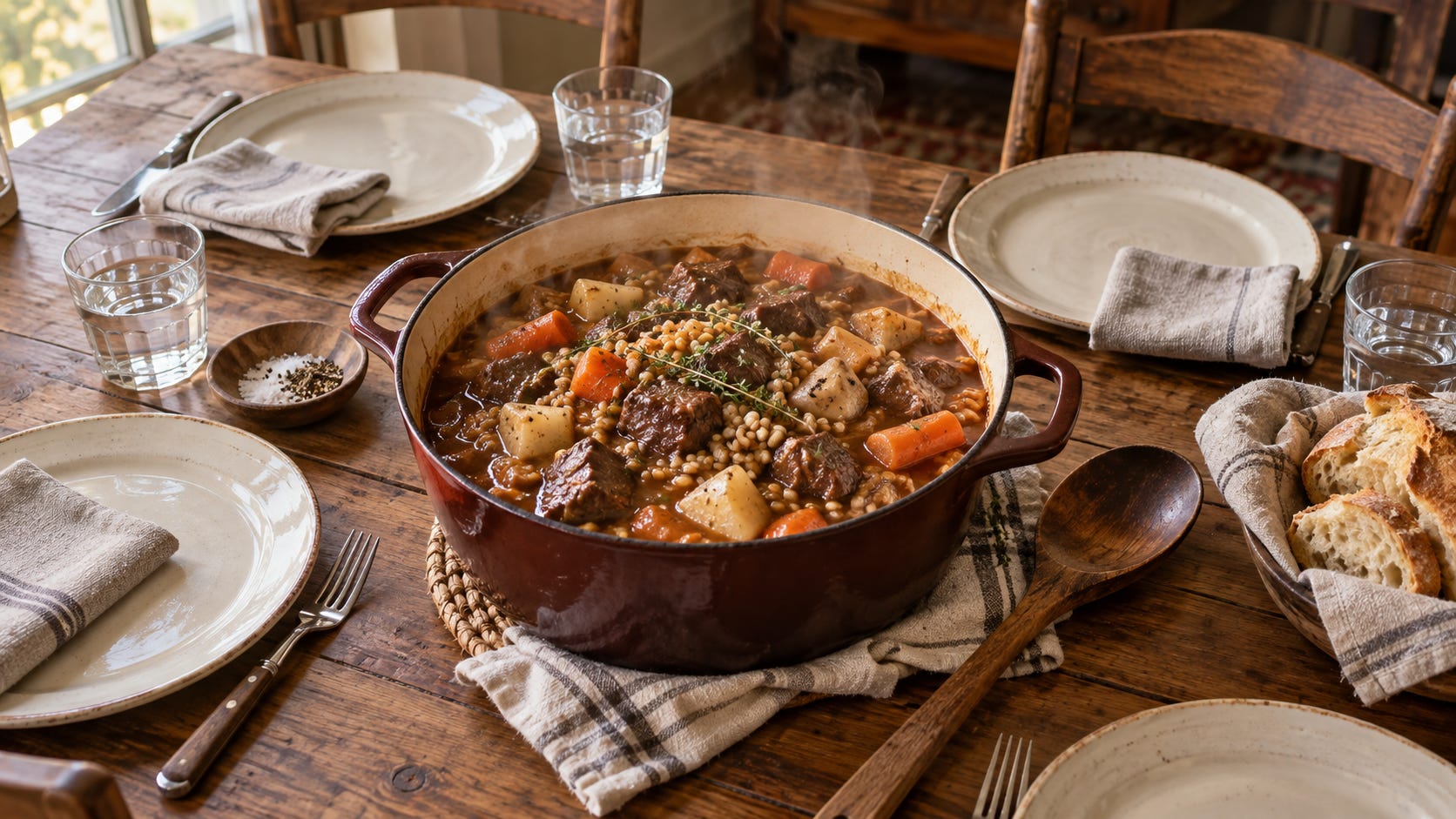
Rustic Beef & Barley Braise with Root Vegetables & Thyme (Featured Recipe)
One-Pan Braised Autumn Greens & Cannellini Beans with Garlic & Lemon
Stovetop Slow-Simmered Tomato & Bacon Jam
Sunday
One-Pot Creamy Wild Mushroom & Parmesan Risotto with Crispy Sage and Toasted Hazelnuts
Warm Skillet Spiced Apple & Blackberry Cobbler
Featured Recipe: Rustic Beef & Barley Braise with Root Vegetables & Thyme
Serves 6
Ingredients
3 lb bottom round roast (rump roast), trimmed
1½ tsp kosher salt
¾ tsp black pepper
2 tbsp olive oil
1 yellow onion, large-diced
3 carrots, thick-cut on a bias
2 parsnips, thick-cut on a bias
2 turnips, cut into rounds
4 garlic cloves, smashed
2 tbsp tomato paste
1½ cups dry red wine
2 cups beef bone broth
¾ cup pearl barley, rinsed
4 fresh thyme sprigs
2 bay leaves
Directions
Season the roast. Pat the roast dry and season all over with salt and pepper. Let sit at room temp 20–30 minutes.
Sear the roast. Heat olive oil in a Dutch oven over medium-high. Sear the roast on all sides until deeply browned, 3–4 minutes per side. Remove and set aside.
Build the aromatics. In the same pot, add onion, carrots, parsnips, turnips, and garlic. Cook, stirring occasionally, until beginning to caramelize, about 8 minutes. Stir in tomato paste and cook 1 minute.
Deglaze with wine. Pour in the red wine and scrape up any browned bits from the bottom. Simmer 2–3 minutes to cook off the raw alcohol smell.
Return roast and add broth. Return the roast to the pot. Add beef broth, thyme, and bay leaves — liquid should reach only 1/3 to 1/2 up the side of the roast, never fully submerged, so the meat braises in gentle simmering liquid and trapped steam rather than boiling. Bring to a gentle simmer on the stovetop.
Braise low and slow, flipping halfway. Cover and transfer to a 325°F oven. Braise 1.5 hours, then flip the roast to the other side for even tenderness. Continue braising until a fork slides in with zero resistance and the internal temp reads 185–190°F, about 2.5–3 hours total, checking liquid level partway through.
Add the barley. Stir the barley directly into the braising liquid around the roast. Cover and continue braising 35–40 minutes, until the barley is tender.
Rest, slice thin across the grain, and serve. Remove thyme sprigs and bay leaves. Rest the roast 10 minutes, then slice thin, across the grain. Serve over the barley and vegetables, spooned with braising liquid.
Notes: Pull the roast at 185–190°F internal, or the moment a fork slides in with zero resistance; bottom round is very lean, and pushing to 200–205°F (right for a fattier cut like chuck) will dry out these fibers instead of tenderizing them further. Keep the liquid at only 1/3 to 1/2 up the side of the roast, never fully submerged — full submersion boils the meat and leaches flavor into the broth rather than concentrating it. Slice thin, across the grain, both for serving and before reheating leftovers — with a lean cut, slicing direction is what makes or breaks perceived tenderness.
Shoppable List
Bottom round (rump) roast
Sweet Italian sausage
Prosciutto
Bacon
Chicken bone broth
Beef bone broth
Pearl barley
Shredded/cooked chicken
Pastina pasta
Yukon gold potatoes
Carrots
Parsnips
Turnips
Yellow onions
Garlic
Swiss chard
Curly kale
Cannellini beans
Cremini mushrooms
Shiitake mushrooms
Arborio rice
Fresh fennel
Hazelnuts
Fresh sage
Fresh thyme
Bay leaves
Lemons
Plum tomatoes
Fig jam
Tomato paste
Brown sugar
Apple cider vinegar
Dry red wine
Dry white wine
Sweet onions
Goat cheese
Ricotta
Sharp cheddar
Parmesan (plus a rind if you have one)
Heavy cream
Butter
Sourdough bread
Crusty bread
Honeycrisp apples
Blackberries
Cinnamon, cardamom, nutmeg
Turbinado sugar
All-purpose flour, baking powder, buttermilk
Curious what’s in my kitchen? [Shop Nonna’s Favorites →]
Cookbook Tie-In
If tonight’s braise has you thinking about slow, comforting cooking all season long, you’ll find more like it in Red, Ripe & Ready and Sun-Kissed — both available in the shop.
Nonna’s Notebook: The Care We Put on the Plate
The other night, I stood at the kitchen counter eating leftovers from a paper plate.
There was nothing particularly wrong with the food. It was perfectly good, and I was perfectly capable of warming it properly, putting it into a bowl, and sitting down at the table. But somewhere between being tired and telling myself it didn’t matter, I decided the paper plate was good enough.
Then I looked at it and thought: What’s wrong with this picture?
If one of my children or grandchildren were sitting in my kitchen, I would never hand them a paper plate of barely warmed leftovers and call it dinner. I would heat the food until it was just right. I would put it in a proper bowl, add a little grated cheese or a piece of bread, and probably ask twice whether they had enough.
We know how to feed the people we love.
We make the soup they like when they are sick. We carry casseroles to people who are grieving. We put a pot of sauce on the stove when the family is coming. We make baked pasta, stew, or chicken and vegetables because one generous dish can feed everyone without requiring a great deal of ceremony.
That is the real comfort in comfort food. It is not only the cream, the cheese, or the long, slow simmer. It is the feeling that someone has considered what might make us feel cared for.
But somewhere along the way, many of us begin to believe that this kind of attention is unnecessary when we are feeding only ourselves.
It isn’t.
A one-dish supper can be humble and still feel like a meal. Leftovers can become dinner again when they are warmed properly and served with care. A bowl, a cloth napkin, a piece of good bread, and five quiet minutes at the table can change the way an ordinary evening feels.
The food does not have to be elaborate. Most comfort food isn’t. It is often something simple and forgiving — a soup that improves overnight, a casserole that waits patiently in the refrigerator, or a pot of something warm that asks very little of us.
Perhaps that is why we return to these dishes. They do more than fill us.
And sometimes the person who needs that care is the one standing alone at the kitchen counter.
Around the House: Back-to-School Sports Season
Back-to-school doesn’t just mean lessons and homework — it means practices, games, and a calendar that fills up faster than I remember it filling up when my own kids were the ones running the drills. Weeknights turn into a shuffle of gear bags, snack duty, and cheering from a folding chair on the sideline, usually with one eye on the clock for whatever’s waiting at home. This is exactly the season a slow cooker earns its keep — something can be quietly doing its thing on the counter while everyone’s out, ready the second the last cleat comes off. It’s not glamorous. It’s just what gets a family through September and October in one piece.
Rotating Feature — Nonna Explains: Why Pastina Is Called “Italian Penicillin”
If you grew up in an Italian household, chances are pastina showed up the moment anyone got sick — a small bowl of tiny star-shaped pasta, swimming in butter, broth, and maybe a little grated Parmesan and an egg stirred through. It’s often affectionately called “Italian penicillin,” and while it obviously has no actual medicinal power, the nickname isn’t entirely a joke. Pastina is easy to digest, gentle on an upset stomach, and — more importantly — it’s usually made by someone who loves you. That combination of comfort and care may do more for how we feel than the soup itself ever could.
It’s not the only dish with a nickname like this. Jewish households have long called chicken soup “Jewish penicillin” for many of the same reasons — a warm, simple dish handed down and made with love whenever someone needs tending to. Interesting how so many cultures landed on the same idea: when someone we love isn’t feeling well, we reach for something warm, familiar, and a little bit healing, even if the “medicine” part is really just the care behind it.
Worth Knowing: Bulk Cooking Saves Time (and Money)
A little planning goes a long way this time of year. Cooking in bulk on a slower weekend — a double batch of soup, a tray of roasted vegetables, extra shredded chicken — means weeknight dinners come together in minutes instead of starting from scratch after a long day. It also tends to save money: buying in larger quantities and using what you have before it goes bad cuts down on both waste and last-minute takeout. A few labeled containers in the freezer now can be the difference between a calm Tuesday and a scramble.
Weekend Kitchen Planner
Friday: Make the Pastina & Chicken Soup start to finish (~40 min). Whip and warm the goat cheese dip just before serving; crisp the prosciutto and grill the sourdough alongside.
Saturday morning: Sear the roast and get the braise into the oven early (about 4 hours total, mostly hands-off). While it cooks: shave the fennel for Sunday, start the Tomato & Bacon Jam low and slow on a back burner, and prep the greens/cannellini side to finish right before dinner.
Saturday evening: Rest and slice the roast, finish the greens side, warm the jam, plate.
Sunday: Make the Mushroom & Parmesan Risotto fresh, start to finish (~40 min active, don’t walk away). Assemble and bake the Apple & Blackberry Cobbler while the risotto rests.
Worth Keeping
“Sometimes the person who needs that care is the one standing alone at the kitchen counter.”
Before You Go
There’s so much coming up this season — in my own household, and in the rhythm of the year itself — that gives us reason to gather. In my immediate family alone, we’ve got seven birthdays and two wedding anniversaries ahead — that’s a lot of cake and a lot of candles (though one family member isn’t a cake person, so he’ll be blowing his out of a blueberry pie instead). I plan to enjoy every bit of it. Football games, harvest weekends, holidays just over the horizon — but honestly, you don’t need a special occasion. Getting together is reason enough in my book.
See you next Friday. Bring your appetite.
— The Jersey Nonna