

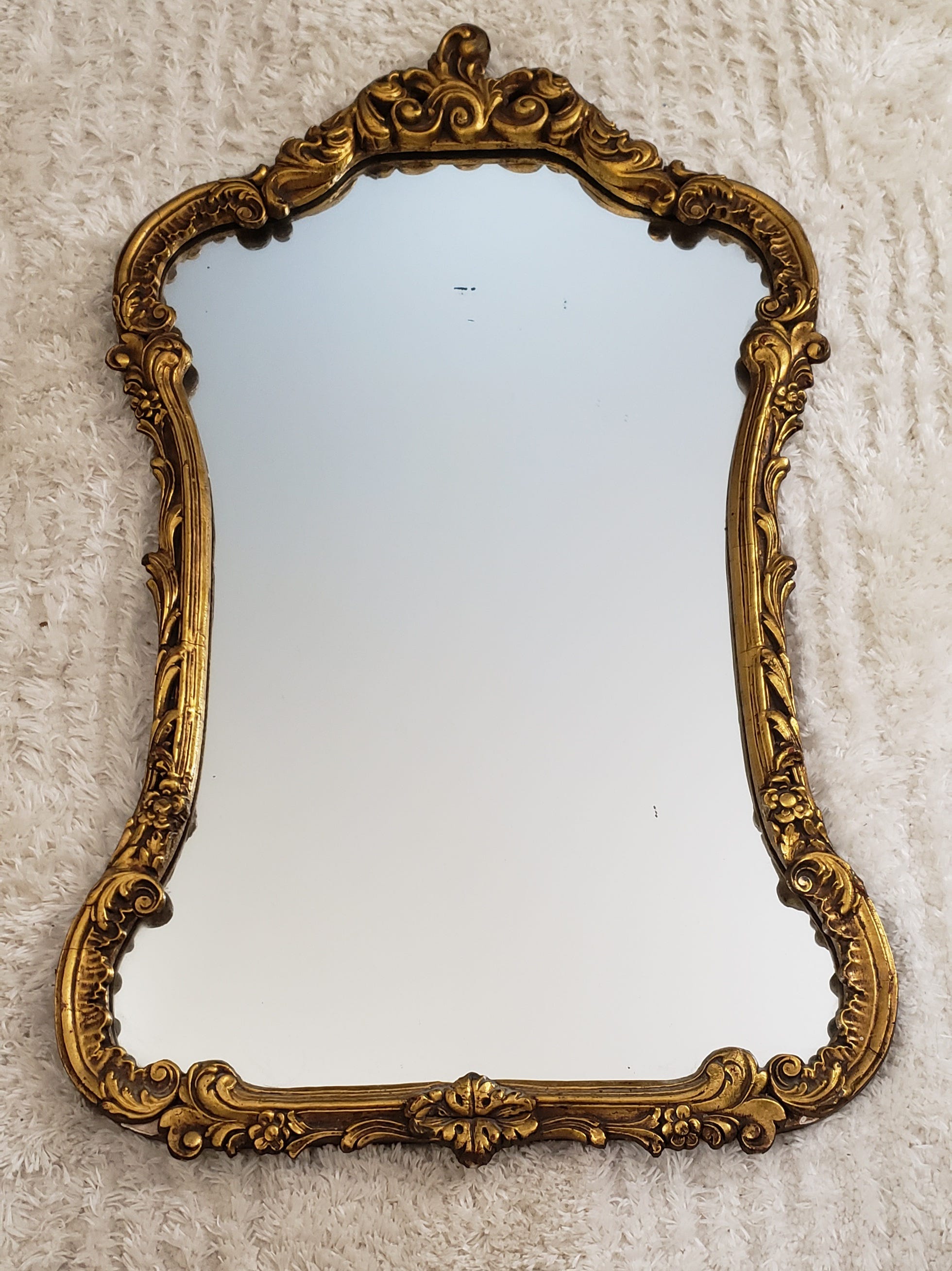
While putting together this season’s Halloween mantel inspiration, I found myself thinking about a mirror I brought home from a thrift shop earlier this year. An old gold frame can give a seasonal arrangement its character, but my attachment to this particular mirror goes beyond decorating.
I first shared its story in Collected Momentum. It belongs here, too, among the things we bring home, live with, and come to treasure.
There is a corridor in my favorite thrift shop that turns halfway down, as if the house itself is deciding whether to reveal more or keep something back. On either side hang artwork and mirrors, layered one against another, some hopeful, some tired, most waiting.
At the very end, almost beside the doorway to pay and leave, it hung slightly higher than my eye level. I am only five feet tall, so many things hang just out of my natural line of sight. But this one caught my eye immediately.
It was ornate. Heavy even from a distance. Antiqued gold, carved wood, unapologetically detailed. Not flashy. Not trendy. Elegant.
Sometimes I circle a piece two or three times before committing. I doubt my instinct. I walk away. I return. I negotiate with myself.
Not this time.
I lifted it down carefully, almost reverently, as though it had already been mine for years. I placed it in the holding area, that small sacred space in a thrift store where a piece waits for its next home. I did not hesitate. I did not second-guess.
It felt discovered.
The shop itself is an old house, cluttered and generous. It requires two passes, sometimes three, to truly see everything. I move through it methodically, slowly. I look for artwork. Mirrors. Architectural pieces. I stand back. I look again. I tilt my head. I imagine placement. I am not there for everything. I am there for the one thing.
This mirror was the one.
An older woman, a volunteer, stood in a doorway as I lifted it down. She watched me with a knowing expression, the faintest smile. It felt like an unspoken exchange between us. You see it too. That one is good. Don’t let it go.
I carried it to the register.
The tag read: $25 — AS IS.
I thought nothing of it at first. It seemed perfect to me.
When the clerk mentioned “as is,” I paused. I laid it gently on the table and ran my fingers along the carved edges, over the curves and flourishes of the wood. I examined the glass closely. Had I missed something? A crack? A chip? A flaw hidden in my enthusiasm?
There were only a few small darkened specks in the mirror itself, places where the silvering had worn thin. Subtle. Honest.
“That’s why,” the clerk said. “It’s old.”
As if age were damage.
As if wear were defect.
I looked again at the small blackened spots and felt something unexpected. They did not diminish it. They validated it. They were proof of time. Proof of presence. Proof that this mirror had hung somewhere long enough to be marked by living.
I would not have wanted it new.
If it had been freshly stamped from a factory mold, flawless and identical to a hundred others, I would have walked past it without a second glance. What drew me was not perfection. It was care.
Someone had shaped—or chosen—these curves with care. The frame, the finish, the glass: together, they had lasted. It was made to last beyond a season, beyond a trend, perhaps beyond its first owner.
I imagine it hanging in a curated Victorian entryway. A last look before stepping out into the world. A welcome home at day’s end.
I see a young woman, hopeful and untested, adjusting her collar before embarking on something new. A mother smoothing her hair, steadying herself before tending to a household. A widow standing quietly, seeing both her present face and her remembered past. A woman returning home tired, catching a glimpse of herself, and gathering the strength to continue.
Each woman saw something different.
And yet, perhaps, they all saw the same things, too. Joy. Fear. Resilience. Sorrow. Becoming.
Now it hangs, for the moment, in my bedroom. I suspect it will wander from room to room before it comes to rest. For now, I see it in the quiet light of morning and again at night before sleep. It greets me at the edges of the day.
When I stand before it, I do not see flaw in the worn glass. I see depth. I see endurance. I see something made with care, still holding its shape after decades.
Grace.
Dignity.
As is.